
By S.M. · 20 months of morning heel pain, tried 4 night splints
7 Reasons Your Morning Heel Pain Keeps Coming Back
That half-second before your foot fully meets the floor each morning — it's decided by what happened to your fascia while you slept.
Your Plantar Fascia Isn't Just Tight. It Tightens Every Single Night While You Sleep — And Nothing You Were Given Has Ever Addressed That.
That changes today. Not because you found more willpower. Because you found the right tool.
If you've tried the boot and given up on it — that wasn't failure. The boot was built for a clinic, not a bed.
You can't wear something through the night if your body won't let you sleep in it. That's not weakness. That's honest.
DorsalFlex was built for how people actually sleep.
A small company has been quietly selling a night splint that does something the orthopedic category hasn't managed in decades: people actually wear it.
You already know what that position costs you.
That first stab when your heel hits the floor. The quick grab for the wall or the bedpost. Those four careful steps before it loosens up enough to walk.
What nobody told you is why that keeps happening. And why the splint didn't change it.
That's what these 7 reasons are about.
"Your First Step Hurts Because Your Plantar Fascia Spends 8 Hours Shortening While You Sleep"
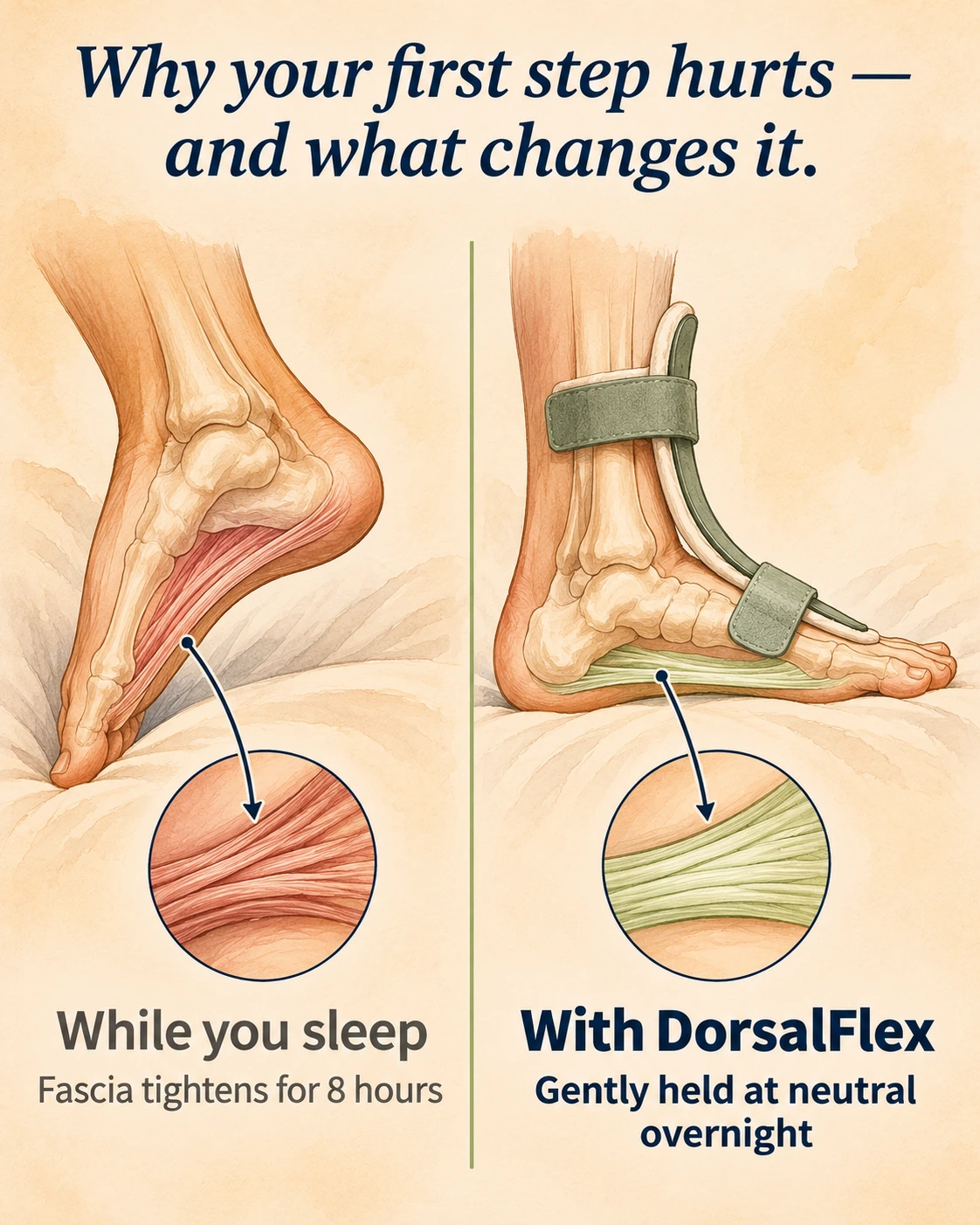
Every night, your foot falls naturally into a pointed-down position — plantarflexion. For 6–8 hours, your plantar fascia rests in a shortened state. When your alarm goes off and both feet hit the floor, that contracted tissue is loaded with your full body weight in an instant.
That's the stab. That's the limp to the bathroom. That's why the pain is sharpest at the first step and fades as you keep moving — the fascia slowly stretches out again as you walk.
The clinical term is plantar fasciitis. The mechanical reality is simpler: nothing you're currently doing changes what happens to your foot between when you fall asleep and when you first stand up.
Arch Supports. Custom Orthotics. Stretches. They All Treat the Wrong Half of the Day.
Everything your podiatrist, physical therapist, and the internet recommended works on the same phase of the problem: the 16 hours you're awake and moving. Arch supports redistribute pressure. Orthotics correct your gait. Morning stretches lengthen the fascia after it's already contracted.
One person wrote, after visiting two podiatrists: "I'm on my second pair of custom orthotics. The first pair was $100. This one's $400. No help at all."
She wasn't failing to do the right things. She was doing exactly what her podiatrist told her. The problem is that everything she was given works on the daytime half of an overnight problem.
Have you spent more than $200 on your feet this year — and still woken up limping?

A Night Splint Was the Correct Answer. The Boot Design Most Doctors Prescribe Is Why It Didn't Work.
In 2023, the American Physical Therapy Association published its Clinical Practice Guidelines and stated: "Clinicians should prescribe a 1-to-3-month program of night splints for individuals with heel pain/plantar fasciitis who consistently have pain with the first step in the morning."
That's the highest clinical recommendation standard — "should prescribe." Not "may consider." Not "as a last resort." Night splints are the evidence-based answer.
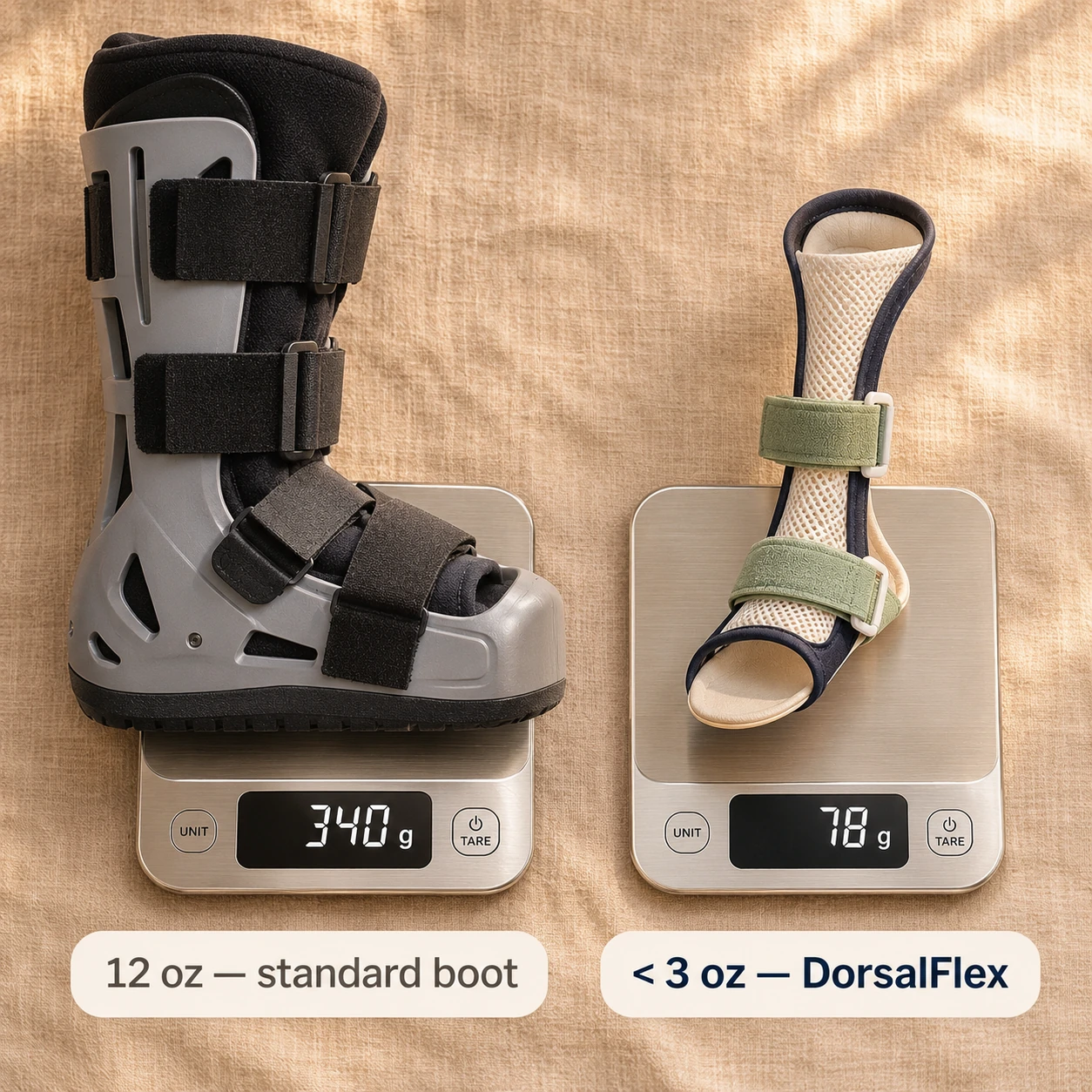
The standard posterior boot — rigid plastic shell running from the ball of the foot to mid-calf — is uncomfortable enough that it comes off. Search any plantar fasciitis forum and you'll find the same thread: "tried a night splint, couldn't sleep, gave up." Not occasionally. Almost universally. The abandonment isn't the exception. It's the rule. The concept wasn't wrong. The implementation was.

Most People Who "Tried a Night Splint and It Didn't Work" Never Actually Wore One Long Enough for It to Work.
The ones who keep trying typically remove it unconsciously in the early morning hours: too hot, too heavy, the rigid shell snagged in the bedsheets. They don't remember taking it off. When you track the data, they did.
One person wrote: "I call it 'the boot.' It's hard, bulky, and uncomfortable. I'm a sound sleeper — I couldn't make it a single night without taking it off in my sleep."
The concept wasn't wrong. You weren't weak. The boot just wasn't engineered for the job it was supposed to do.
Is there a night splint sitting in your closet right now that you haven't touched in months?
Most Night Splints Wrap Around Your Leg. This One Crosses the Top of Your Foot. That's Why It Stays On.
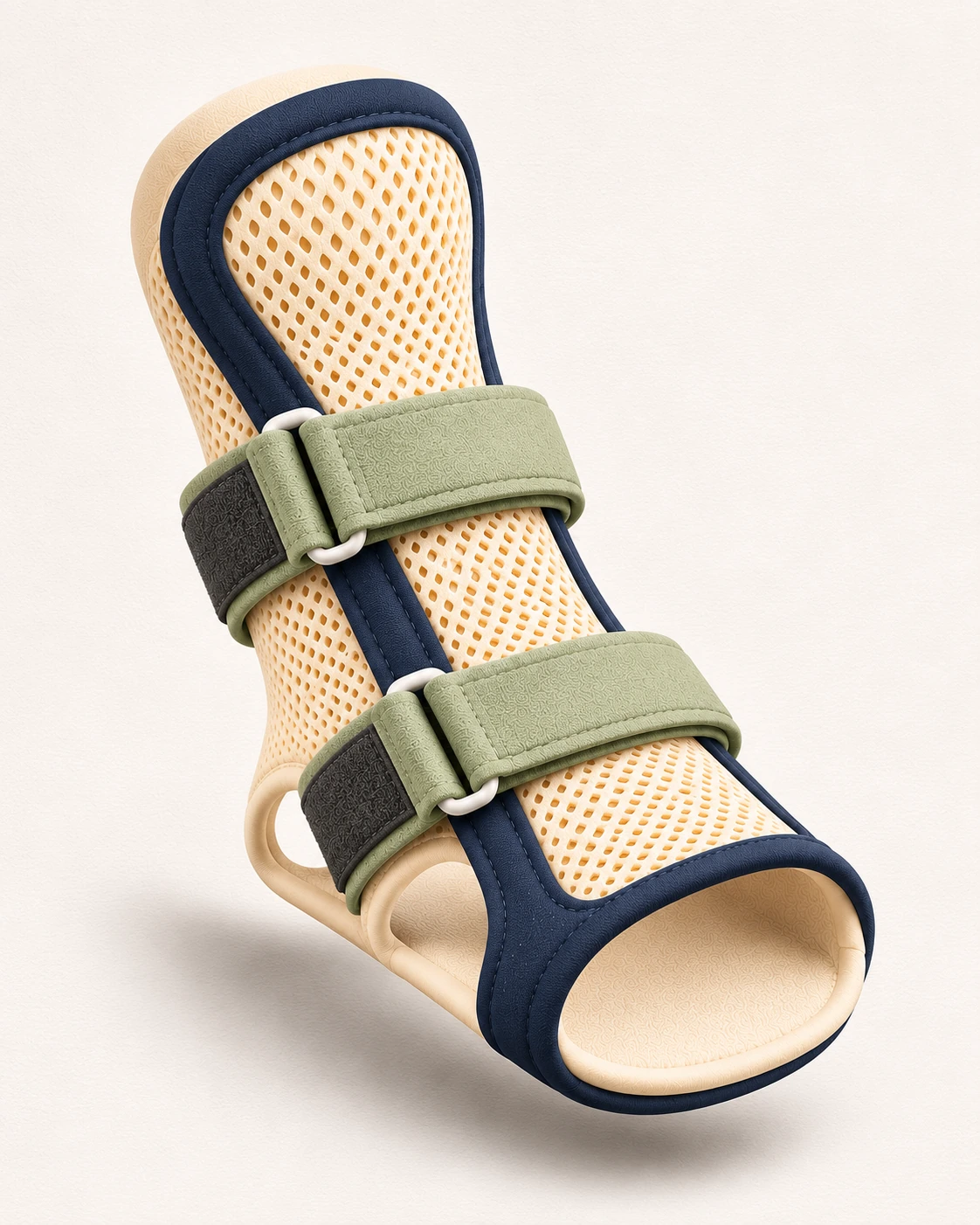
DorsalFlex crosses the dorsal side of your foot — the top — with a padded strap. No rigid shell. No full lower-leg encasement. Under 3 ounces. Open heel, open sole, open toes.
It holds your foot in the same therapeutic position as the posterior boot — keeping the fascia gently lengthened through the night — without the heat, the pressure, or the bulk that makes the boot unwearable. Micro-adjustable tension lets you dial in exactly how much stretch you need.
"I don't believe I wasted my time for TWO YEARS when it was this easy to get rid of the pain."
— Category experience (not a DorsalFlex review)Here's what most night splints miss: comfort isn't a bonus. It's the mechanism.
Compliance is what makes them work. Comfort is what makes compliance possible.
If you can't sleep in it, you stop wearing it. If you stop wearing it, the science never works.
That's why the dorsal design matters. It removes what woke you up. No rigid shell pressing against your shin. No strap cutting into the top of your foot at 2 AM. Nothing to kick off.
We call this The Overnight Thaw.
Your fascia needs a full night held at the right length. DorsalFlex gives it that night. The tissue wakes up loose instead of shortened. And your first step is different.
60-Night Morning Walk Guarantee — your mornings decide, not us
Free Shipping · No Subscription · Order by 2 PM ET — ships tonight
People Who Had Completely Given Up on Night Splints Are Now Walking to the Kitchen Without Thinking About Their Feet.
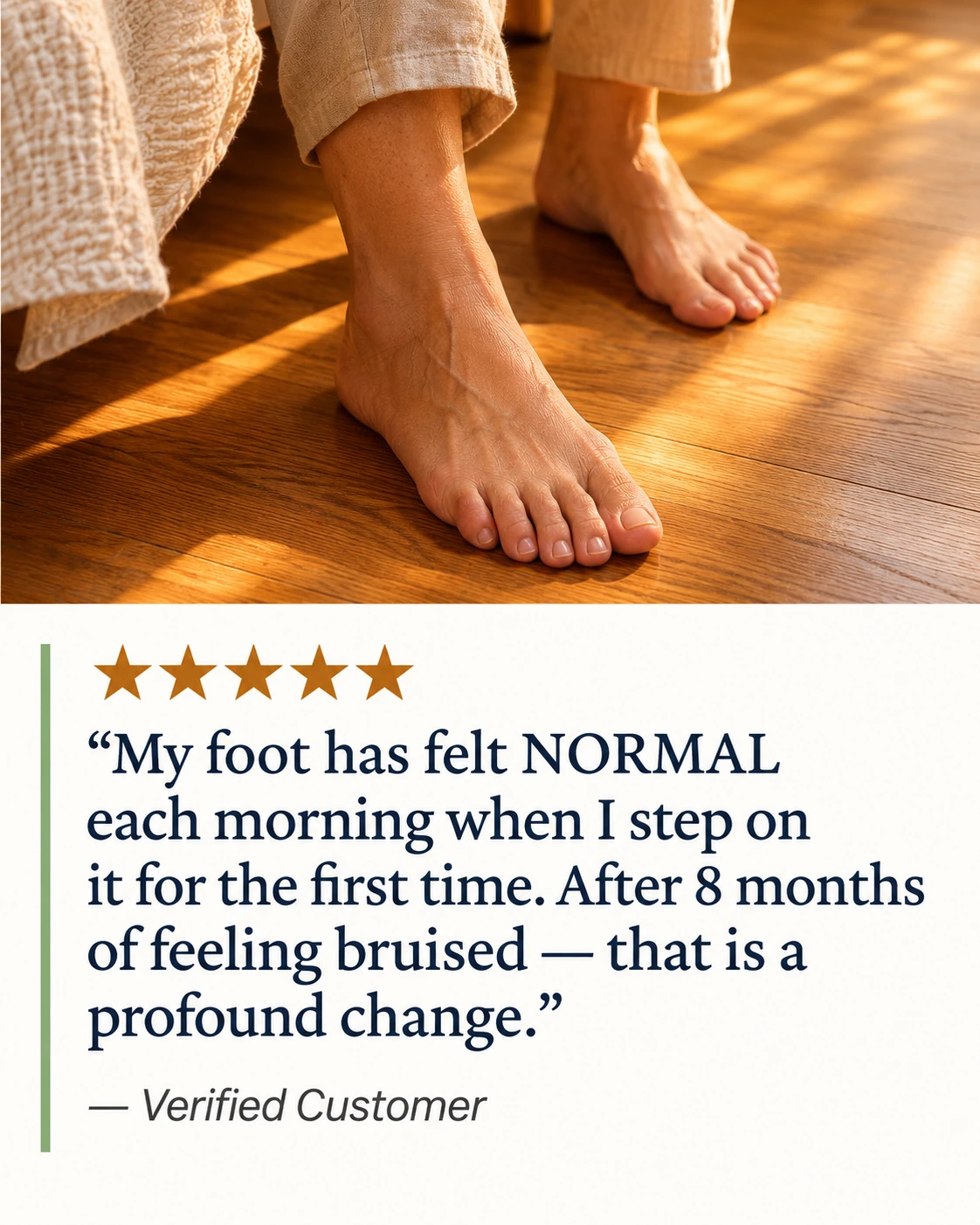
Imagine the morning after two weeks. Your alarm goes off. You sit up. Both feet flat on the floor. No reaching for the wall. No sharp intake of breath before the first step. You just — stand up. Walk to the kitchen. That's not a recovery story. That's a normal morning. The kind you stopped counting on having.
And here's what you won't expect: it's not the pain-free step that changes your day. It's everything the step leads to.
Your friend texts "morning walk?" and you text back "yes" without checking how your foot feels first. Your husband stops asking "how's the foot?" because there's nothing to ask about. Your grandkids don't notice anything different — and that's exactly the point.
You haven't become a different person. You've taken away the design problem that was recreating the injury every single night.
The person who hobbles to the bathroom, plans her day around her feet, skips the morning walk because she doesn't know what kind of morning it'll be — that isn't who you are. That's what chronic pain teaches you to call yourself when nothing has worked long enough.
Normal mornings aren't a fantasy you've outgrown. They're just what comes back when this specific, fixable thing gets fixed.
When was the last morning you didn't think about your feet before standing up?

Try It for 60 Mornings. If Your First Step Doesn't Feel Different, You Pay Nothing.
The 60-Night Morning Walk Guarantee: Try DorsalFlex for 60 nights. If your first step isn't measurably easier, return it for a full refund. No questions, no forms, no fine print about "proper use."
Here's why 60 nights matters: the first 2–3 nights feel unusual. Your body isn't used to sleeping with your foot in a lengthened position. By night 5–7, most people stop noticing the splint. By week two, the overnight positioning starts changing what their first step feels like.
You're not being asked to decide whether this will work for you. You're being asked to try it. Your mornings decide — not us.
DorsalFlex™ Dorsal Night Splint
Most people who've been dealing with this for more than six months have spent $300–$600 on things that helped a little and then stopped. DorsalFlex is currently at the founding customer price — the launch rate for the first production run, before the price moves to $79. At $59, that's less than $1 per night for your first 60 mornings.
About 1 in 3 cases affect both feet
$45+ in recovery tools for $19 more than 2-Pack
60-Night Morning Walk Guarantee · Free Shipping · No Subscription
If your mornings don't change, you pay nothing.
Customer experiences
The experiences below describe night-splint use in the broader category. They are not verified reviews of FirstStep DorsalFlex. Individual results vary.
I had a posterior night splint for two years. Never made it through the night. Tried DorsalFlex and woke up two nights in a row with it still on. My first step this morning was genuinely the least pain I've had in a year.
Three years of plantar fasciitis. I'd stopped believing it would ever change. I bought this mostly because of the guarantee. Five weeks in, I'm wearing it every night and my first step out of bed is finally something I don't dread.
I move a lot in my sleep — previous splints were always on the floor by morning. The DorsalFlex has stayed on five weeks running. My morning stab is 80% gone. Keeps getting better week by week.
On my feet 10 hours a day. By month two my heels were ruining my mornings. The first week with DorsalFlex was strange but by week three I stopped bracing for the first step. Standing on the floor isn't a thing I think about anymore.
60-Night Morning Walk Guarantee · Free Shipping · No Subscription · Order by 2 PM ET — ships tonight
Still reading?
That's the right instinct. You've been down this road before. You know what it costs — in money, in sleep, in the quiet adjustments you've made to your mornings without telling anyone. The skepticism is earned.
Here's the only thing worth saying at this point: your fascia will shorten again tonight. That's not a scare — it's just the mechanical reality. Eight hours of sleep, foot pointed down, tissue contracting. It happens whether or not you do anything about it.
The clinical guidelines say a night splint is the answer. But the boot most people try — rigid, heavy, hot — comes off before morning. A splint that comes off at 2 AM gives the concept an 8-hour job and 4 hours to do it in. DorsalFlex crosses the top of your foot instead of encasing your leg. Under 3 ounces. Open heel, open toes. It stays on because there's nothing to kick off.
What you're being asked to decide isn't whether this will work. You can't know that from here. You're being asked to try it long enough to find out. Sixty mornings. If your first step isn't measurably easier, you pay nothing.
The worst outcome is sixty mornings from now, nothing changed, and you got your money back. That's not a risk. That's a sixty-night test your foot gets to run for you.
Sixty mornings. If your first step isn't measurably easier, you pay nothing.